• de
    • en
Frank Rödel
  • HOME
  • WORKS
    • WORKS START 2019
    • WORKS UNTIL 2018
    • PHOTOGRAPHY
    • VISIT THE STUDIO
  • THE ARTIST
    • ABOUT ME
    • VITAE
    • TIME TRAVEL
    • PUBLICATIONS
    • BIBLIOGRAPHY
    • INDIVIDUAL EXHIBITIONS
    • GROUP EXHIBITIONS
    • PUBLIC COLLECTIONS
  • FILMS
  • NEWS
  • LINKS
  • CONTACT
  • HOME
  • WORKS
    • WORKS START 2019
    • WORKS UNTIL 2018
    • PHOTOGRAPHY
    • VISIT THE STUDIO
  • THE ARTIST
    • ABOUT ME
    • VITAE
    • TIME TRAVEL
    • PUBLICATIONS
    • BIBLIOGRAPHY
    • INDIVIDUAL EXHIBITIONS
    • GROUP EXHIBITIONS
    • PUBLIC COLLECTIONS
  • FILMS
  • NEWS
  • LINKS
  • CONTACT
    • de
    • en
  • WORKS START 2019
  • WORKS UNTIL 2018
  • PHOTOGRAPHY
back to overview WORKS UNTIL 2018

MASADA - ISRAEL


Masada Statement – I was not allowed to study in the German Democratic Republic [former East Germany] and had to endure the complete loss of all personal freedoms, individual rights and dignity for more than three years while a political prisoner.  Out of this experience
of being completely stripped of my individuality and freedom grew a counter reaction: the complete focus on art, which I see as the most individual of all lifestyles.  A further result of this experience is my overwhelming need to search for themes and take working trips all over the world.
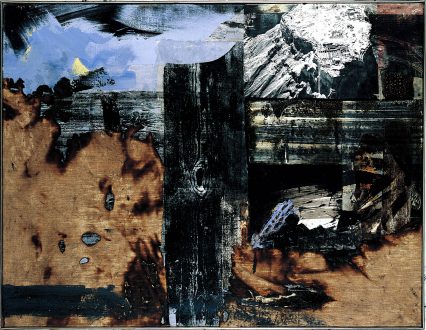
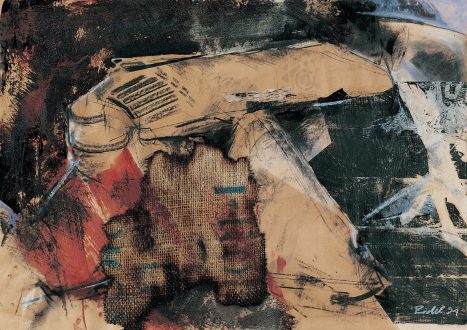
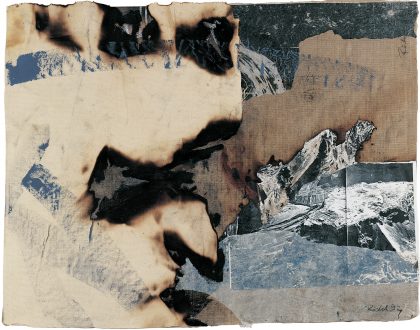
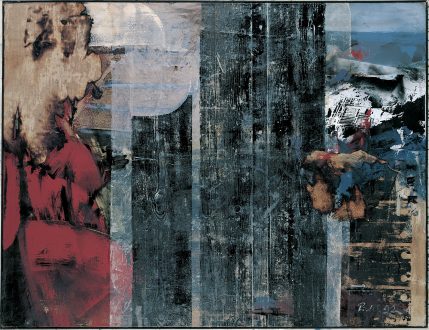
My “Masada” series of paintings directly addresses the question of the value of freedom; in ancient Judaea almost 1000 Zealots freely choose death over slavery and their loss of freedom.

Masada
For an exhibition of my works in 1990 in Jerusalem, I have to
thank the place which in the Jewish world carries so much
weight, which is so important in Israel: the Masada Fortress
on the Dead Sea.
Formerly a fortress belonging to Herod, during the Judeo-
Roman war of 70-72 AD, a group of 960 Zealots took cover
in this huge cliff stronghold, the last bastion of resistance
against the Roman superpower.
Almost 500 metres above the Dead Sea and with cliff walls
of up to 200 metres vertical drop, Masada was considered
impregnable. Well supplied with food and water, the
defenders’ resistance could not be broken by a siege. So
Flavius Silva, the Roman Governor in Jerusalem and commander
of the Roman forces, decided to build a 180-metre
high ramp from earth and rock, despite the constant barrage
from the defenders, in order to get a wall-breaking war
machine to the fortress. When the Romans succeeded in
breaking through the four-metre thick wall and set light to
another wall built in a hurry from sand and wood, it was
impossible for the defenders of Masada to experience the
next day in freedom.
Eleazar, the leader and commander of the Zealots, convinced
his followers in a barnstorming speech, to commit
suicide rather than suffer a humiliating end or slavery.
The Jewish historian, Flavius Josephus, reported, “without
hurting them, our women should die without having tasted
the fate of serfdom, our children! And after their end, we
want to kill ourselves for love, and the safeguarding of
freedom will be the most beautiful memorial.”
Ten men were ordered to kill the others and themselves.
Only two women and four children, who had remained
hidden, survived.
When the Romans, expecting fierce resistance, stormed the
empty fortress and understood what had happened, they
were moved to despair and their victory was without joy.
“No cries of joy passed over the lips of the Roman victors
and across the desert there descended an almost unnatural
silence.”
If you stand today on the cliff of Masada and look down on
the ramp, on the siege walls and the surrounding walls of
the Roman attackers, you feel the sense of the atrocity.
Masada is not only a tense place of pilgrimage for streams
of tourist pilgrims. Masada touches on a great topic of
humanity, it touches on the question of the value and price
of human life and freedom, a question which in the 20th
century has not lost any of its pertinence.
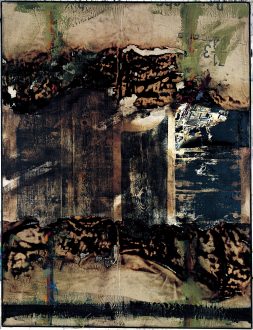
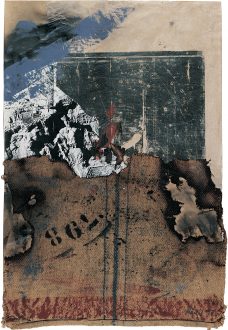
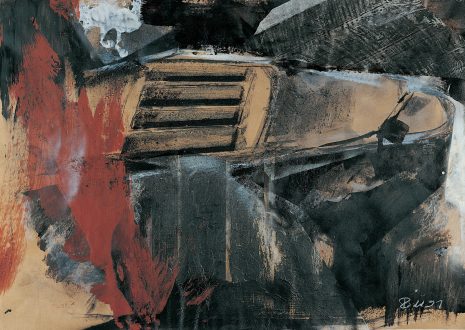
As an artistic challenge, Masada is huge, the age of thundering
battle paintings is over. Different, contemporary,
more subtle approaches must be found which are artistically
adequate for the theme. The work with different materials
such as coal, chalk, wood cuttings and wood presses,
dispersing colours, asphalt, burnt and signed canvas, sand
and collaged parts of current aerial photographs of the
fortress are the media for this attempt to make the location
and the events an associative experience. On the one
hand there is the heavy clay colour which corresponds to
the apparent lack of vegetation of the ravaged place in
the desert with its searing heat, and on the other hand, the
red is the only colourful increase in intensity which makes
the mental closeness to the colour of blood and flames
possible without wanting to force them.
Anyone who has experienced Masada, will recognise the
topographical situation of her place and the objectiveness
of the form of the cliff, the ramp, the army camp, Herod’s
palace and in some of the works even the shimmering of
the Dead Sea in the distance, amongst all the abstraction.
For me, incoherence as a way of avoiding foreground is a
principle for the contents. In my opinion, to make the theme
associatively “approachable” for the onlooker would be
the best possible success.
In 1991/1992, with interruptions I worked on the theme for
almost two years and when describing it in looking back, it
is an emotional presence for me, as though there were no
time gap.
Frank Rödel 1997

read more

Masada VI

130 x 170 cm

Masada VII

Masada VIII

170 x 130 cm

Masada II

95 x 70 cm

Masada IV

70 x 95 m

Masada V

70 x 95 cm

Masada III

80 x 95 cm
Frank Rödel
  • HOME
  • WORKS
  • THE ARTIST
  • FILMS
  • Blog
  • LINKS
  • VISIT THE STUDIO
  • LEGAL NOTICE
  • Privacy
    • de
    • en
© Frank Rödel 2021
Scroll Up